
Financing
Available!
Quartzite vs Granite for Las Vegas Outdoor Kitchens
Both are natural stone. Both survive the desert. Only one is right for your counter — and after setting both in hundreds of valley backyards since 1998, we can tell you exactly how to decide.
Quartzite vs Granite at a Glance
The scoreboard first, the reasoning after. Grades reflect performance in Southern Nevada conditions specifically — full desert sun, 115° summers, 60° day-night swings.
| Category | Quartzite | Granite |
|---|---|---|
| Hardness / scratch resistance | Exceptional — harder than granite | Excellent |
| Heat performance | Excellent | Excellent |
| UV / fade resistance | Excellent — colors hold | Excellent |
| Stain resistance | Very good, sealed | Very good, sealed |
| Maintenance | Seal every 1–2 years | Seal every 1–2 years |
| Appearance | Dramatic, marble-like movement | Speckled, granular, huge variety |
| Cost | $$$ — typically 30–80% more | $$ — the value benchmark |
| Surface heat in full sun | Lighter slabs stay comfortable | Dark slabs run hot to the touch |
| Best for | Showpiece kitchens, luxury homes | Working kitchens, best value |
Considering porcelain too? We compared that against granite separately: porcelain vs. granite.
Know Your Stone
What Is Quartzite?
Quartzite starts life as sandstone, then gets cooked and compressed deep in the earth until it recrystallizes into something harder than granite. The result looks like marble — flowing veins, luminous whites and grays, real drama — but behaves like armor. One caution from the field: quartzite is chronically mislabeled at stone yards. Softer marbles and dolomites sometimes wear the quartzite name tag and fail outdoors. Part of what you hire us for is knowing true quartzite from a costume — we've been burned-tested by this desert enough times to check.
What Is Granite?
Granite is igneous rock — cooled magma, crystallized over millions of years into the speckled, granular stone everyone recognizes. It's been the outdoor kitchen standard in this valley for decades for good reason: enormous color variety, proven desert performance, and the best price-to-durability ratio in natural stone. When we say "the value benchmark," that's not faint praise — most of the 1,000+ projects we've built carry granite, and they're still carrying it well.
The Head-to-Head, Category by Category
Everything below comes from stone we've set, sealed, and revisited across Las Vegas, Henderson, and Summerlin — not from a supplier's brochure.
Heat Performance — Tie
Both stones shrug off a hot platter straight from the grill; neither will scorch or crack from cookware heat. The desert's real heat test is different: thermal cycling — 60-degree swings between a July afternoon and a desert night, thousands of times. Both stones pass when properly fabricated and supported. Where builds fail is at seams and overhangs done cheaply — a fabrication problem, not a stone problem.
Surface Temperature — Advantage: Lighter Stone (Either)
Here's the category brochures skip: how hot the counter gets to the touch. That's driven by color more than mineral — a dark absolute-black granite in full afternoon sun can genuinely burn a forearm, while a light quartzite or white granite stays usable. Since quartzite skews light and granite's most popular outdoor colors skew dark, quartzite wins this in practice — but a light granite beats a rare dark quartzite. We map sun exposure at the design stage for exactly this reason.
UV / Fade Resistance — Tie
Natural stone doesn't fade the way engineered quartz (a different product — resin-bound, and not recommended outdoors here) or laminates do. Ten-year-old granite and quartzite installs we revisit still hold their color. This is the single biggest reason both stones beat most alternatives in this climate.
Stain Resistance — Slight Advantage: Quartzite
Sealed, both resist wine, citrus, and grease well. Quartzite's density gives it a slight edge when the sealer is due — it buys you more forgiveness on the margarita that sat overnight. Either way, the real answer is a good sealer on schedule, which takes twenty minutes a year.
Scratch Resistance — Advantage: Quartzite
Quartzite is measurably harder — it will dull your knife before your knife marks it. Granite is no slouch; in practice both survive real kitchen use, tumbled ice bins, and dropped tongs. If you have teenagers who treat counters like cutting boards, quartzite's margin is real.
Maintenance — Tie
Identical care: penetrating sealer every one to two years (more shade = less often), mild soap for cleanup, no harsh chemicals. Your walkthrough care guide covers the exact products for your slab. Neither stone is "high maintenance" — that reputation belongs to marble, which we don't install outdoors here.
Appearance — Your Call, Honestly
This is taste, not performance. Quartzite reads like marble — long veins, movement, the counter people photograph. Granite reads like granite — speckled, mineral, endlessly varied, from near-black to salt-and-pepper to warm golds. In our portfolio: the L-shaped quartzite island in North Las Vegas and the quartzite-and-stucco kitchen with the kamado show the drama; the Henderson stacked-stone island with granite shows how right the classic still looks.
Cost — Advantage: Granite
Expect quartzite to run 30–80% more than granite installed, with exotic slabs going higher. On a big kitchen that's a four-figure gap — real money that could fund a side burner and lighting instead. Whether the upgrade is "worth it" depends entirely on which scenario below is yours. (For full project budgeting, start with our Outdoor Kitchen Cost Guide.)
The Builder's Recommendation
What we'd put in our own backyard, by situation. This is the answer clients actually ask for — so here it is in writing.
Best for Full Sun
Light quartzite. A west-facing counter with no shade needs a surface that stays touchable at 4pm in July. Light quartzite delivers that and looks like a million dollars doing it. Light granite is the value alternative.
Best for Luxury Homes
Quartzite, no contest. In The Ridges or MacDonald Highlands, the counter should match the home's ambition — and quartzite's marble-like movement is the look those kitchens deserve. It's what we spec for our showpiece builds.
Best Value
Granite. The best durability-per-dollar in natural stone, period. A mid-range granite outperforms its price forever — and frees budget for the appliances and lighting that change how the kitchen gets used.
Best Low Maintenance
Honestly? A tie — same sealing schedule, same cleanup. If "never seal anything again" is the actual goal, the true answer is porcelain, and we'll tell you so: read the porcelain comparison.
Best Resale Value
Quartzite by a nose in luxury zips, granite everywhere else. Buyers in premium neighborhoods notice quartzite; in most of the valley, a clean granite kitchen photographs beautifully and returns its cost. Never over-stone the neighborhood.
Best for Heavy Weekly Use
Either — fabricated well. The stone that fails is almost never the mineral; it's the cheap seam, the unsupported overhang, the skipped sealer. Both stones outlive the grill if the build respects them.
Both Stones, In Real Backyards
Every photo is a Sun West build — several featuring the exact counters this guide compares.
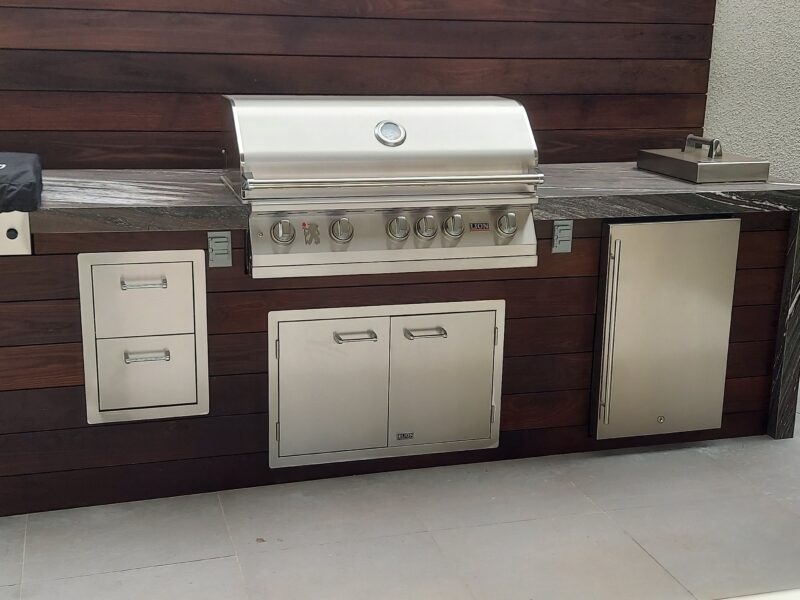
Custom BBQ island featuring a Lion L90000 built-in grill, stainless double doors and drawers, outdoor refrigerator, and rich wood-look paneling with a polished stone counter. Built…
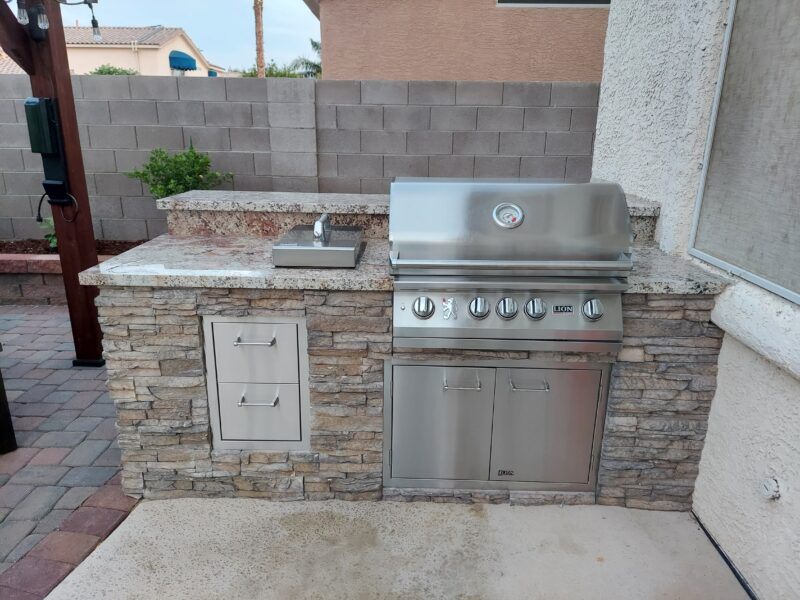
Custom stacked stone BBQ island with a built-in stainless steel grill, prep sink, storage doors, and granite countertop on a brick paver patio in Henderson, NV.
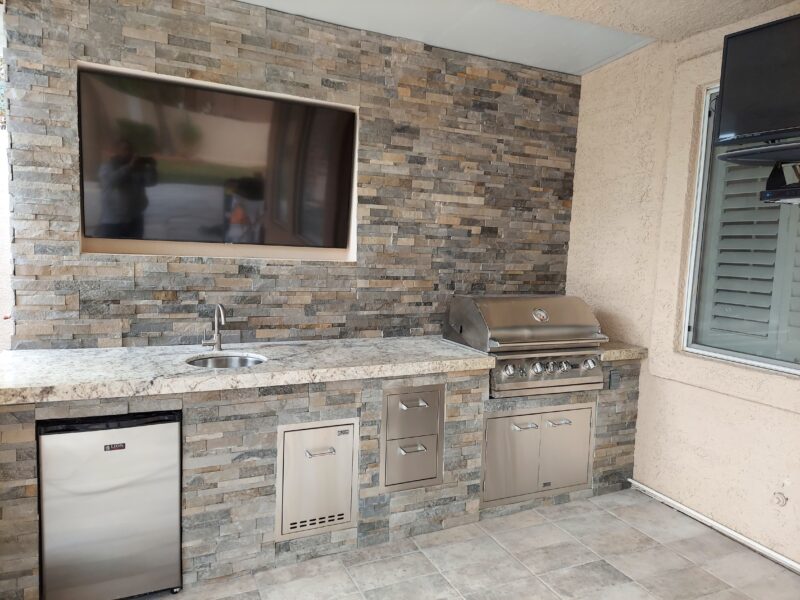
Custom outdoor kitchen built against a stacked stone accent wall with mounted TV, granite counters, built-in grill, prep sink, and outdoor-rated refrigerator. Las Vegas, NV.
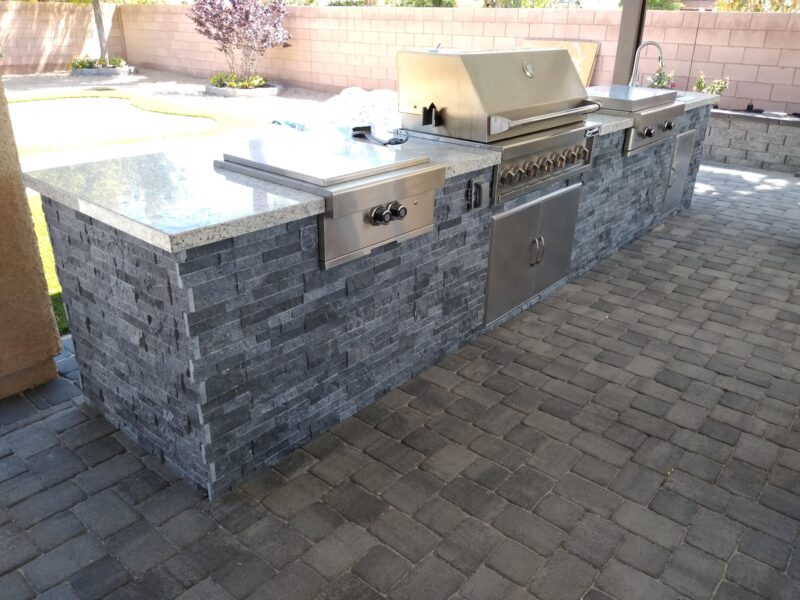
L-shaped BBQ island in gray stacked stone with a polished quartzite countertop, built-in grill and storage, set on a paver patio in North Las Vegas, NV.
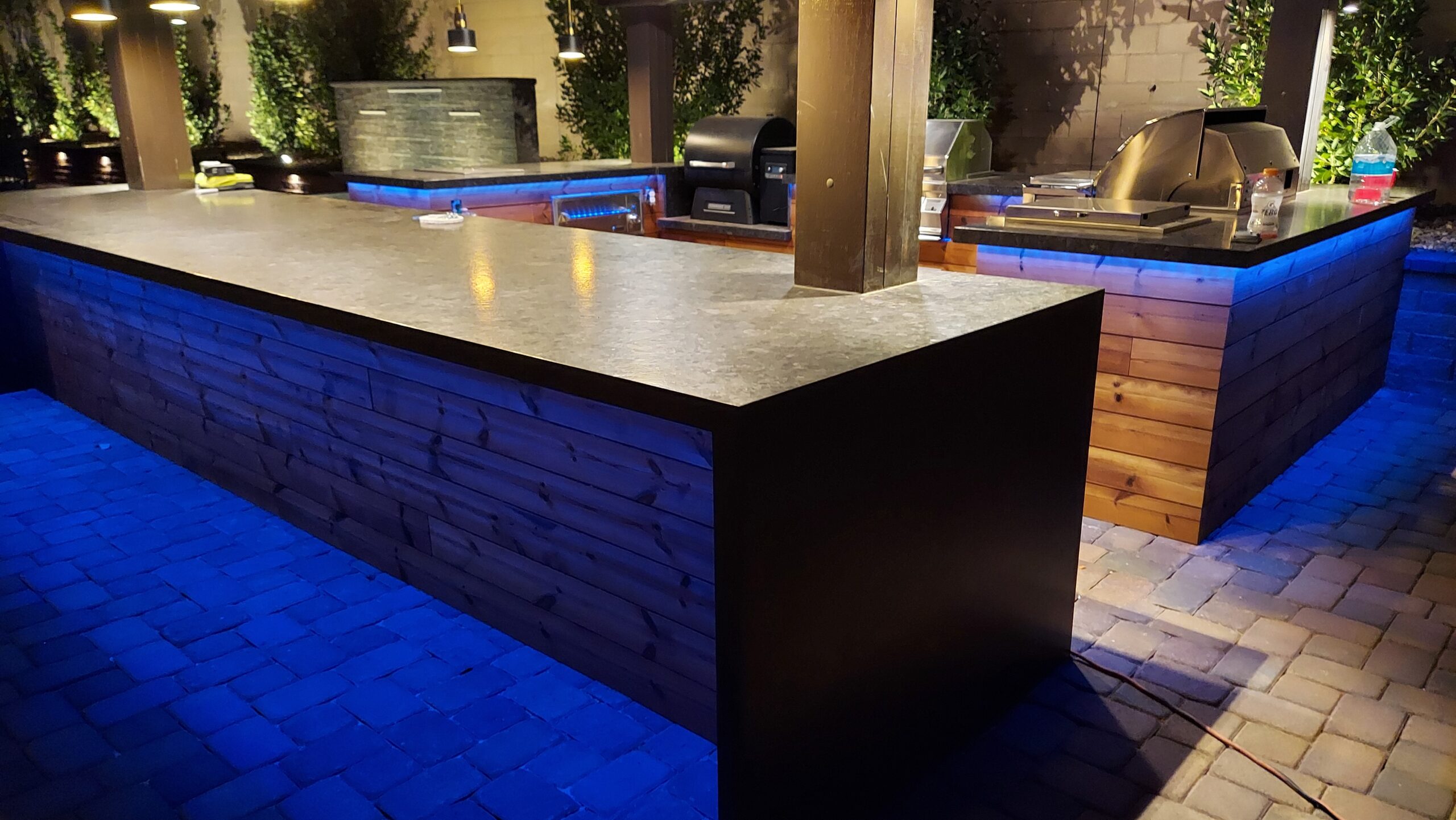
Custom BBQ island with Thermory wood finish, granite countertop, and dramatic blue LED accent lighting shown at night in Las Vegas, NV.
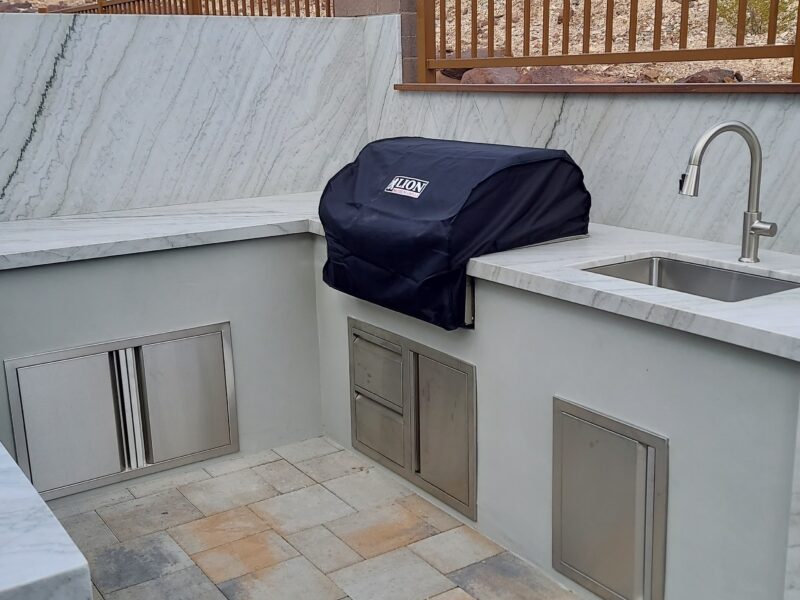
Bright outdoor kitchen featuring quartzite countertops, smooth stucco finish, prep sink with pull-down faucet, and built-in appliances in Las Vegas, NV.
Countertop Questions, Answered
Both are excellent in the desert — the honest answer depends on your situation. Quartzite wins for full-sun counters (lighter colors stay touchable), luxury homes, and scratch resistance; granite wins on value and color variety. Our full builder's recommendation by scenario is in the guide above.
No — and this matters outdoors. Quartzite is 100% natural stone and thrives in the desert. "Quartz" counters are engineered stone bound with resin, and that resin yellows and degrades in UV — we do not install engineered quartz outdoors in Las Vegas, whatever the showroom says.
Color decides more than mineral: dark slabs in full afternoon sun get genuinely hot; light slabs stay usable. We map your sun exposure at design and steer the slab choice accordingly — it's one of the most valuable five minutes of the consultation.
Every one to two years for both stones — a twenty-minute wipe-on job. Shaded counters go longer; full-sun counters run the shorter end. Your walkthrough care guide names the exact sealer for your slab.
Typically 30–80% more installed, with exotic slabs above that. On a full kitchen that's often a four-figure difference — worth it for showpiece and full-sun builds, and honestly not worth it if the budget would come out of appliances. See the cost guide for full project budgeting.
Yes — both handle cookware heat without scorching. We still suggest trivets for cast iron straight off the flame, mostly to protect the sealer's lifespan rather than the stone itself.
Sealed properly, both resist stains well; quartzite's density gives it slightly more forgiveness when the sealer is overdue. The real stain risk on any stone is a lapsed sealing schedule — which is why ours comes with a reminder.
Porcelain is the third strong option — non-porous, zero sealing, crisp modern look — with its own trade-offs. We compared it against granite here: porcelain vs. granite. Many of our modern builds use it.
Yes — that's how we prefer it. We bring samples to your design consultation so you see both against your home's stucco and your patio's light, and slab-yard visits are part of the process for showpiece projects.
Call (702) 201-7724 or request a free consultation. We'll look at your sun exposure, your style, and your budget — and give you a straight recommendation with samples in hand.
Decide With the Stone in Your Hand
Samples on your patio, in your light, against your house — with a straight recommendation from the builder who'll set the slab. Free, and worth more than every comparison chart on the internet, including this one.
Licensed · Bonded · Insured | NV Contractor Lic. #0095511 | Financing Available