
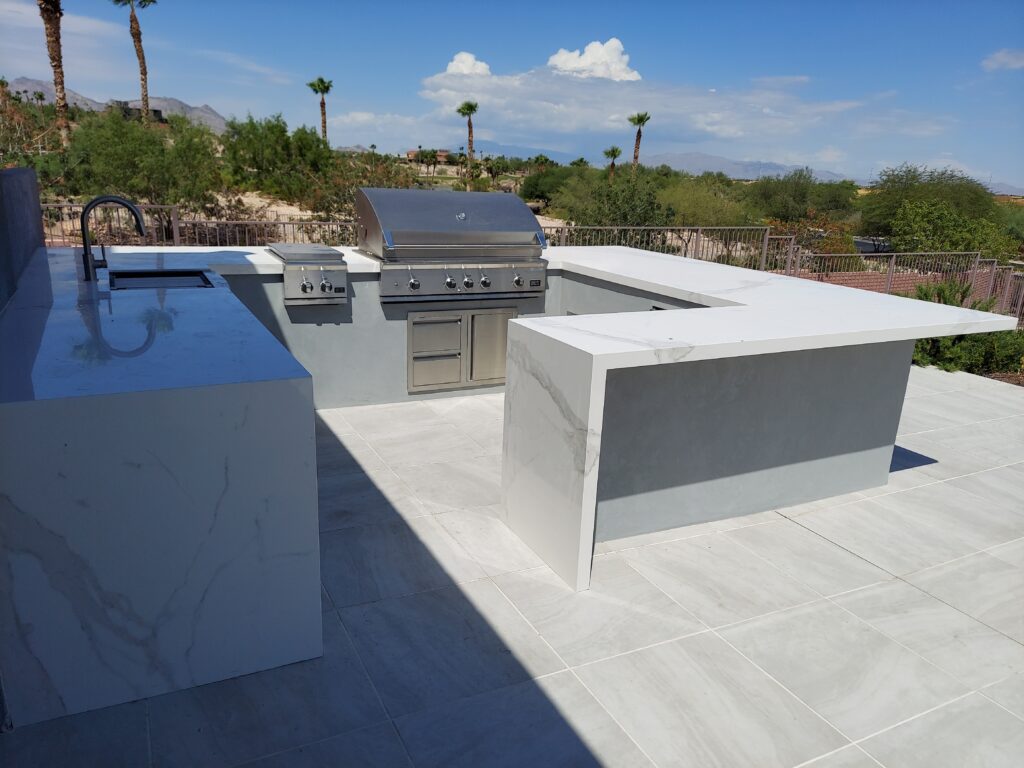
Durability and performance in the Las Vegas climate
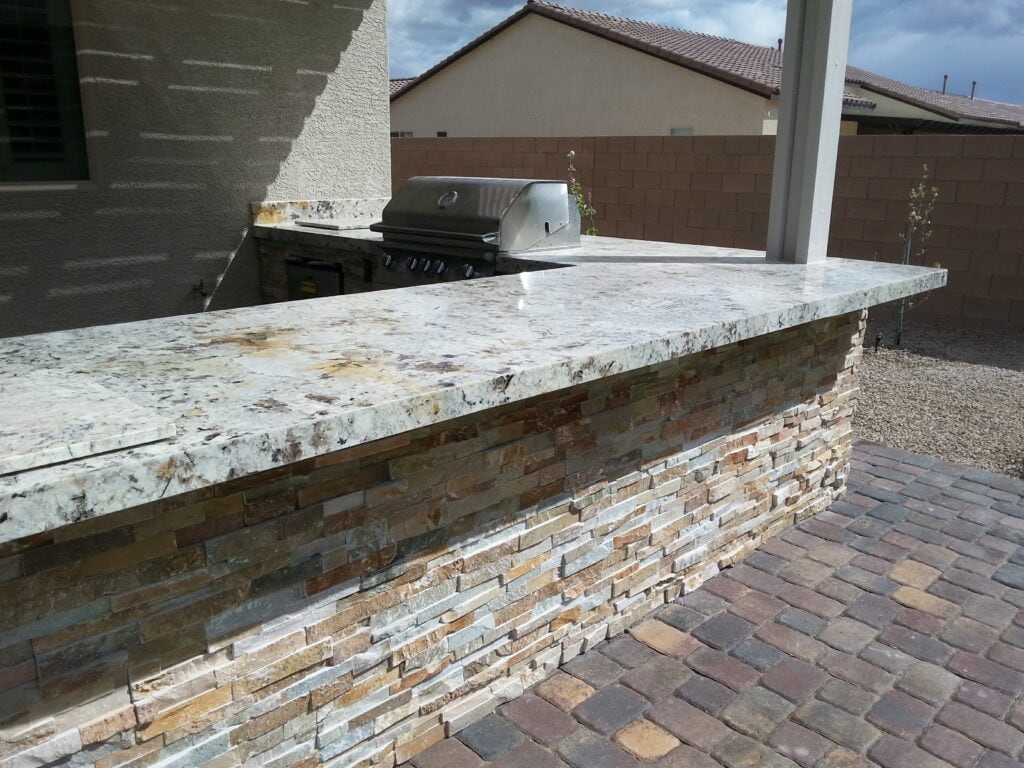
Selecting a countertop in the desert involves understanding how extreme heat, direct sunlight, and wide temperature swings impact different materials over time. While both granite and porcelain offer high functional performance, they behave differently when exposed to the harsh conditions typical of a regional backyard landscape.
Heat resistance and direct sun exposure
Both materials are fundamentally capable of handling hot cooking implements, but their reaction to ambient heat differs. Granite is a naturally occurring volcanic rock, which means it remains cool to the touch even in high summer temperatures, yet it can crack if subjected to extreme thermal shock. Porcelain is fired at incredibly high temperatures during manufacturing, making it highly heat resistant and unlikely to warp or expand significantly when local temperatures spike.
Impact strength and scratch resistance
Granite is renowned for its exceptional density, making it one of the most scratch-resistant surfaces available for any culinary setup. While strong, chipping is possible at sharp edges if a heavy object is dropped with great force. Porcelain, while remarkably durable and capable of resisting most daily wear, is often thinner than granite slabs and relies on a well-built sub-structure to maintain its integrity against high-impact force.
Porosity and moisture absorption properties
One of the most significant performance differences lies in how these materials interact with moisture and external liquids. The following table illustrates the typical performance metrics for outdoor applications in the region.
| Feature | Natural Granite | Outdoor Porcelain |
|---|---|---|
| Porosity Level | Varies (High to Low) | Non-Porous |
| UV Fade Resistance | Prone to Fading | Excellent |
| Maintenance Needs | Requires Periodic Sealing | Very Low |
| Weight | Exceptionally Heavy | Moderate |
The data confirms that because natural granite is naturally porous, it essentially demands a high level of care in environments where food prep and liquid spills are constant, whereas porcelain stands as a barrier against moisture intrusion.
Aesthetic range and design versatility
Visual appeal drives many design decisions, and today’s options allow homeowners to create everything from rustic desert havens to modern, minimalist escapes. The choice between a completely unique piece of nature or a controlled, engineered appearance often depends on the overall style of your outdoor living zone.
Natural veining of granite vs. engineered patterns
Granite offers a sense of organic luxury because no two slabs are ever identical, featuring deep mineral deposits and chaotic, beautiful veining. If you prefer a consistent look that mimics marble or slate with industrial-grade uniformity, porcelain allows for specific, repeatable patterns that Sun West Outdoor Kitchens can integrate into your custom layout.
UV stability and color fading
Darker granite colors can sometimes lose their luster or undergo mineral oxidation when subjected to years of intense UV rays. Porcelain is specifically engineered for UV stability, meaning the pigments used during the manufacturing process are designed to resist fading and remain vibrant, protecting your design investment against the harsh desert sun.
Availability of slab sizes and edge profile options
Granite slabs are available in traditional large dimensions but often require visible seams in larger outdoor islands. Porcelain manufacturers have scaled production to include massive, large-format panels that can cover extensive workspaces with minimal interruption, resulting in a cleaner, modern look for any backyard media wall or cooking island.
Maintenance and cleaning requirements
Keeping your outdoor kitchen in top condition relies on understanding what each surface requires throughout the year, especially given our local climate. Establishing a consistent care routine ensures that your outdoor investment retains its value and remains a welcoming space for family gatherings.
Periodic sealing for natural stone surfaces
Because granite is naturally porous, it needs to be protected from grease, acidic juices, and rainfall. A high-quality, penetrating sealer must be applied annually to ensure the stone does not absorb residues, which is an essential part of the life-cycle maintenance cost for natural stone owners.
Daily cleaning routines for low-maintenance porcelain
Porcelain is arguably the easiest surface to manage on a day-to-day basis, requiring only the gentlest cleaning protocols to remove debris or food spills. You can maintain your surface efficiently by following these simple steps:
- Wipe down surfaces with a mixture of warm water and a drop of pH-neutral soap.
- Use a soft-bristled brush or damp cloth to clear any loose dust or localized grime.
- Avoid using scouring pads that could dull the surface over several years of use.
- Rinse with clean water and dry with a microfiber cloth to prevent water spots.
By sticking to this straightforward regimen, you ensure the hygienic quality of your workspace without needing harsh chemicals or complex cleaning supplies.
Chemical resistance and sanitization for food prep
Porcelain is inherently resistant to harsh chemicals, enabling the use of standard sanitizing agents without risking surface damage or discoloration. Whether you are prepping sides or cleaning up after a large event, the surface stays pristine because it does not harbor bacteria in microscopic pores.
Structural considerations and professional installation
Designing a functional outdoor island involves more than just selecting a beautiful top; the underlying frame must be capable of supporting the weight of the material. Whether you choose stone or porcelain, professional planning is the only way to avoid long-term structural failures or settling issues.
Handling the weight of natural stone slabs
Natural granite is dense and incredibly heavy, creating significant vertical load on any kitchen cabinet or framing structure. Because of this weight, the masonry foundation beneath the granite must be expertly engineered with reinforced CMU or steel components to prevent it from cracking under pressure.
Sub-structure requirements for outdoor kitchen islands
Regardless of your choice of stone or porcelain, the sub-structure must be built to withstand the desert’s extreme thermal expansion and contraction. At Sun West Outdoor Kitchens, we focus on building durable frames that move correctly with the ground environment to protect your chosen surface from tension stress.
Importance of hiring a qualified outdoor kitchen contractor in Las Vegas
Working with a professional Outdoor Kitchen Contractor Las Vegas ensures manufacturer requirements and material-specific installation techniques are followed correctly. An experienced partner like Sun West Outdoor Kitchens provides the specialized design knowledge required to navigate the unique challenges of constructing outdoor spaces in the intense high desert environment.
Cost analysis and long-term value
Evaluating the cost of your island involves looking beyond the upfront purchase price to the long-term reality of ownership. When you factor in the labor, materials, and potential for future repairs, you get a much clearer picture of the true ROI of your investment.
Comparison of material costs and fabrication fees
Granite prices can fluctuate significantly depending on the rarity of the quarry and the complexity of edge fabrication required for the project. While porcelain may have higher initial material costs due to advanced manufacturing, its ease of installation and reduced material waste can make it a competitively priced option for modern, efficient builds.
Expected lifespan and return on investment
Both materials are built for decades of performance if sourced from reputable suppliers and installed by professionals. Choosing a surface that matches your lifestyle needs will provide an excellent ongoing return on investment by ensuring that your outdoor space remains a functional and highly attractive part of your primary residence.
Factoring in life-cycle costs for sealers and repairs
Natural stone requires an annual investment in professional-grade penetrating sealers to remain stain-resistant. When you account for the cost of these recurring supplies and the time required for consistent maintenance, you might find that the lower long-term cost of porcelain helps offset its initial entry price, making it a budget-friendly option for the busy homeowner.
Conclusion
Choosing between granite and porcelain ultimately comes down to your personal aesthetic preference and your willingness to maintain the surface. Whether you desire the organic, singular beauty of granite or the clean, resilient performance of engineered porcelain, both options offer a permanent upgrade to your home. By leaning on local expertise for the design and construction phase, you can ensure that your backyard island is ready to serve as the heart of your outdoor living experience for many years to come.
Frequently Asked Questions
Can granite be installed outdoors in extreme heat?
Yes, granite is a natural stone that handles outdoor heat effectively, though it requires specific maintenance and sealing to protect against UV exposure and potential moisture intrusion.
Does porcelain scratch easily?
Porcelain is extremely hard and maintains its finish remarkably well under daily use, though it is always recommended to use cutting boards rather than cutting directly on the surface.
How often should granite be sealed?
Granite should generally be resealed once a year to maintain its resistance to stains and weather, though high-traffic or high-exposure areas may require more frequent assessment.
Is it possible to use granite for a kitchen island without seams?
Due to the size of natural stone quarries, most large outdoor kitchen islands will require at least one or two seams; professional installation teams work to ensure these transitions are as subtle as possible.
Does the color of porcelain fade when exposed to the sun?
One of the primary benefits of engineered porcelain is that it is highly UV-stable and maintains its original color and aesthetic regardless of long-term exposure to direct sunlight.
What sub-structure is needed for these materials?
Both stone and porcelain require a robust, level sub-structure, typically made of reinforced concrete or steel, to support the weight of the material and prevent cracking.
Are these surfaces safe for direct food contact?
Both materials are excellent for food preparation, with porcelain being particularly hygienic due to its non-porous nature, which prevents the absorption of bacteria and food particles.
[…] The sides are wrapped in travertine ledger stone — a natural stone that takes the desert heat without fading and gives the island real texture instead of a flat stucco box. The counter is porcelain, one of our favorite surfaces for Las Vegas valley builds: it shrugs off UV, doesn’t need sealing, and stays cooler to the touch than darker stone. (We compared outdoor counter materials in depth in our porcelain vs. granite guide.) […]
[…] Granite is the value benchmark and a proven outdoor performer, and modern porcelain and Dekton slabs offer ultra-consistent, low-maintenance surfaces. We’ll walk you through the trade-offs — including our take on porcelain vs granite. […]